
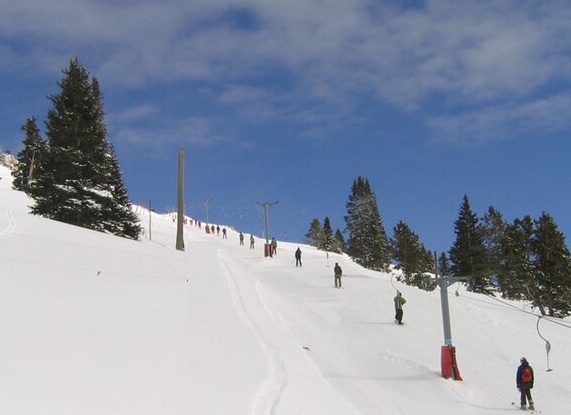
The Rope Tow
There used to be a little ski mountain near Warren, Pennsylvania called "Buckaloons". The first time I was ever on skis (except in the back yard) was at Buckaloons. There was a rope tow that would take you up to the top of the bunny slope. You'd grab hold, and up you would go -- no problem unless you got lost your footing, or the person ahead of you did.
The rope tow is a good metaphor for spiritual life. The rope's there, running, ready to pull. There's a constant stream of love and wisdom, from the Lord, running down the mountain to the bottom, turning around, offering handholds, and running back up the mountain towards conjunction with Him. If we grab hold, it will tug us upward. If we don't, it keeps running, ready for our next spiritual decision. While we flounder around.
Is there any Biblical basis for this metaphor? Yes:
"Jehovah has been seen far off to me, saying, And I have loved thee with an eternal love; therefore with mercy have I drawn thee." (Jeremiah 31:3)
"And my hand has found, as a nest, the belongings of the peoples; and as one gathers forsaken eggs, so I have gathered all the earth; and there was not one that flew away on the wing, or that gaped with the mouth, or that chirped." (Isaiah 10:14)
"And I, if I be lifted up from the earth, will draw all to Myself." (John 12:32)
"But looking at the strong wind, he feared, and beginning to sink, he cried out, saying, Lord, save me. And straightway Jesus stretching out the hand, took hold of him, and says to him, O thou of little faith, why didst thou doubt? (Matthew 14:30-31)
And when Jesus is being crucified with the two thieves, one "grabs the rope tow", and one doesn't:
"And one of the malefactors who were hanging beside Him blasphemed Him, saying, If Thou be the Christ, save Thyself and us. But the other, answering, rebuked him, saying, Dost thou not fear God, because thou art in the same judgment? And we indeed justly, for we receive the things of which we are worthy for what we have committed, but this Man has committed nothing amiss. And he said to Jesus, Remember me, Lord, when Thou comest in Thy kingdom. And Jesus said to him, Amen I say to thee, today thou shalt be with Me in paradise." (Luke 23:39-43).
And finally, here's a passage from "True Christian Religion":
"In actual fact there is a kind of field that constantly emanates from the Lord, which pulls all toward heaven. It fills the entire spiritual world and the entire physical world. It is like a strong current in the ocean that secretly carries ships along. All people who believe in the Lord and live by His commandments come into that field or current and are lifted up. Those who do not believe, though, are not willing to enter it." (True Christian Religion 652)


